
Get the printed kit
Printed in the materials we know work and shipped cleaned up and ready to assemble. The fastest route to water.
- Checked part by part before it ships
- Supports removed, ready to assemble
- Hardware list included
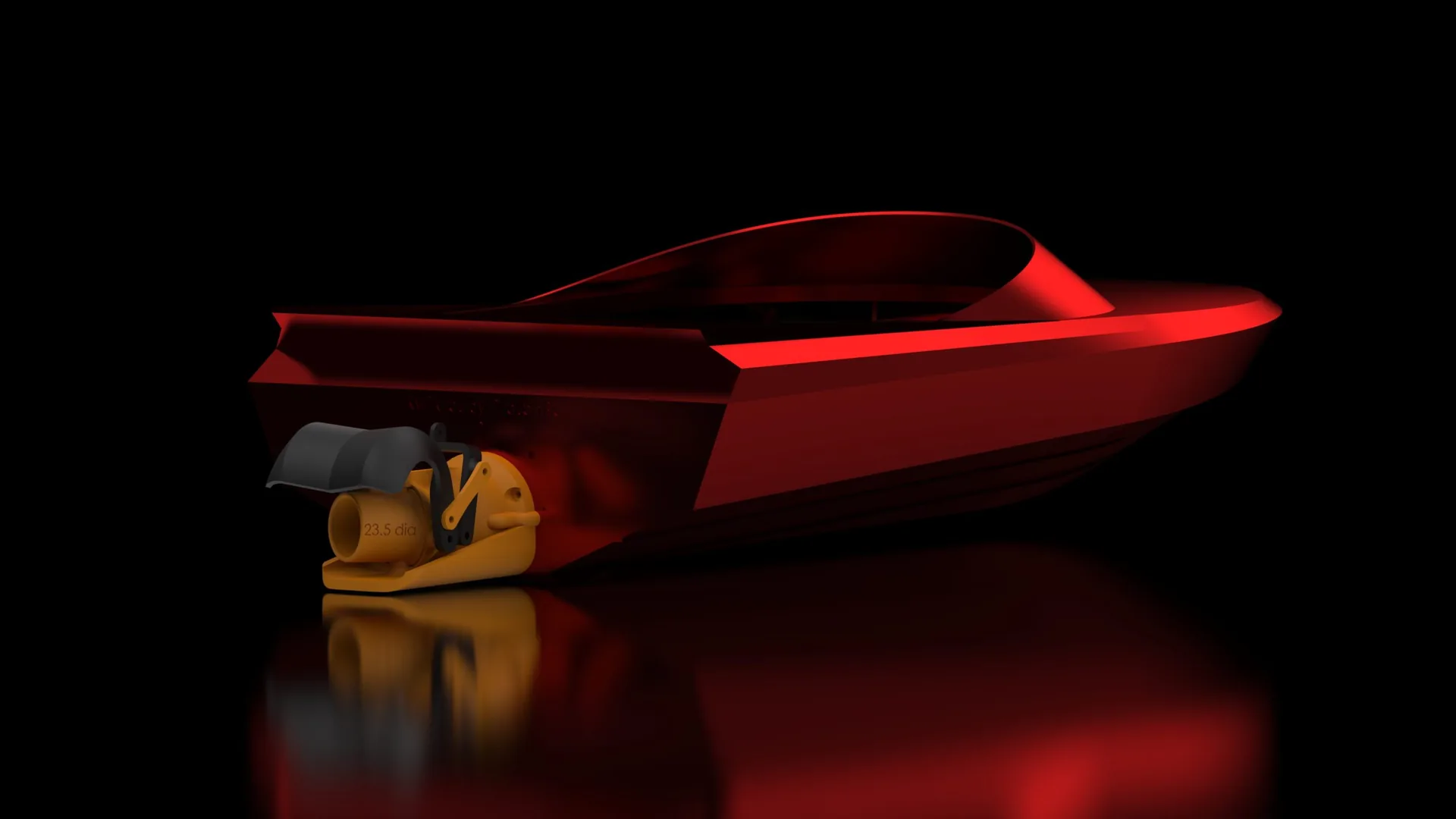
The classic
The boat that started it all — and still the quickest way in.
Since 2019
KwikJet was our first jetboat, released on 4 January 2019. Depending on how you configure it you can see well over 50 km/h. It is built to shrug off the shallowest, nastiest water, and with almost no delay between the trigger and the thrust it is simply a very good time.
It is still the boat we hand to someone building their first jetboat. Small enough to throw in a bag, quick enough to keep you honest, and cheap enough that a mistake at the waterside is a lesson rather than a disaster.

The jetpump
Everything that makes the boat go happens inside one assembly: water in through the hull, 35 mm of pump, and out through a 23.5 mm nozzle you can aim. Here is what each part of it is doing.
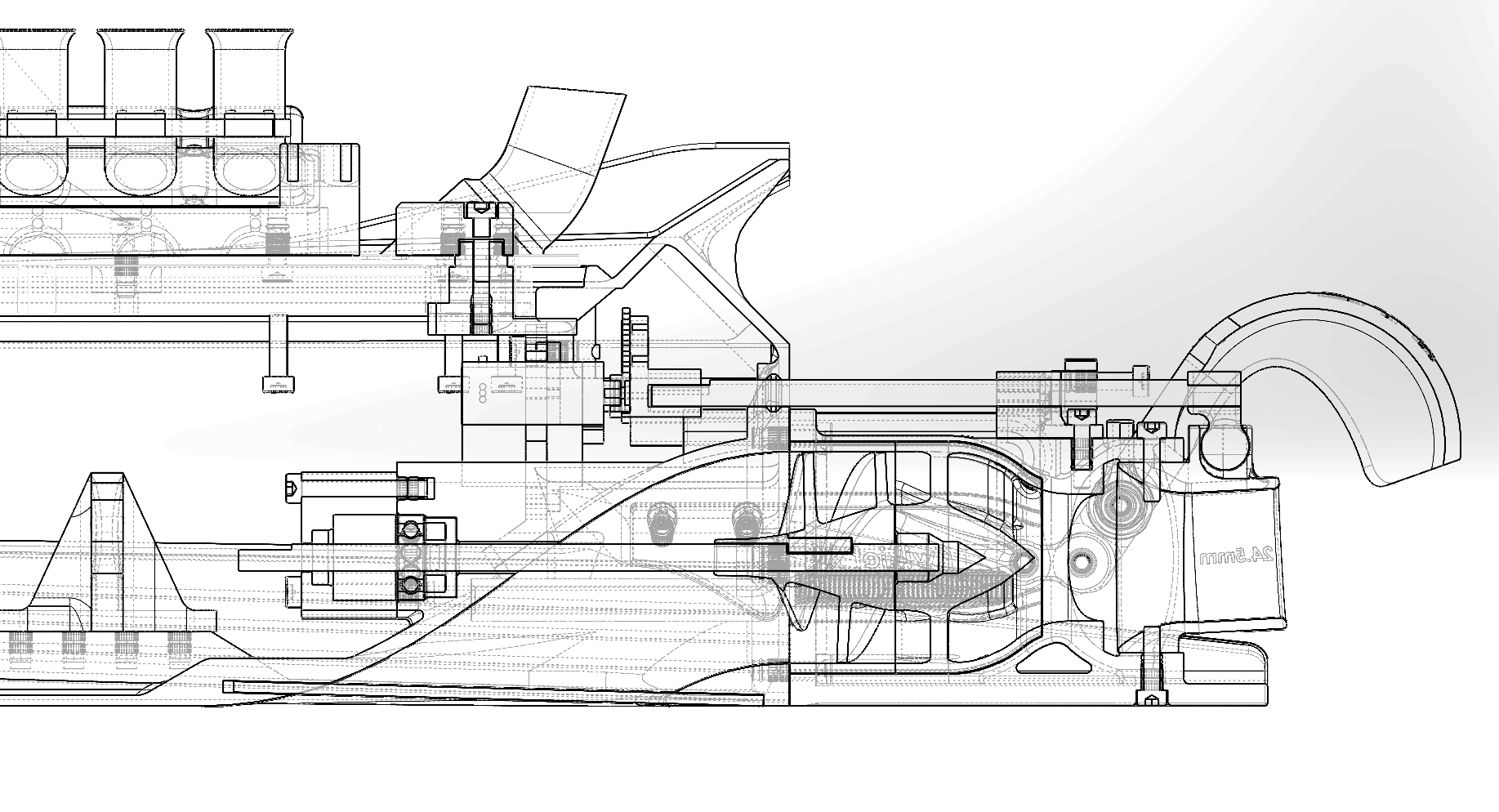
35 mm bore 23.5 mm nozzle
Scroll the diagram sideways
A slot set flush into the bottom of the hull, behind a grate, feeding a long shallow tunnel. The boat is moving, so water is effectively rammed in rather than sucked — which is why a jetboat gets more efficient the faster it goes. Nothing protrudes, so there is nothing to shear off.
Bolted straight to the motor shaft — no gearbox, no lag. The flow divides around the hub and passes either side of it, and the blades screw it along the housing, adding pressure as it goes.
Water leaving an impeller is spinning, and a spinning jet is wasted thrust. Fixed vanes take that swirl out as the two paths rejoin behind the hub, turning it back into straight-line pressure.
Here the pressure becomes speed. The 35 mm bore necks down to 23.5 mm — about 2.2× less area — so the same water has to leave that much faster than it was travelling inside. And because the whole nozzle swivels, you are aiming the thrust itself.
Drop the bucket into the jet and the same thrust is thrown forward and down instead of back. Full reverse, and — held halfway — the fine control that lets you hold the boat still against a current.

The pump
A 35 mm pump sitting entirely inside the hull, driven straight off the motor. Squeeze the trigger and the boat simply goes — there is no propeller to spool up and nothing under the hull to catch a rock. The whole assembly comes apart with a screwdriver, which is how it survives a season of shallow water.
What you get
Up to 52 km/h on a 3S pack, depending on the motor and impeller you choose. The direct-drive pump means no delay — just thrust.
The 35 mm pump that made the KwikJet name, exiting through a 23.5 mm nozzle: compact, efficient and endlessly rebuildable.
Nothing hangs below the hull. Run it up rivers, over gravel bars and through water no propeller boat would survive.
Deploy the bucket for full reverse and precise docking — the same mechanism the X inherited.
Around 35 minutes on two 2200 mAh 3S packs, so a session is limited by your attention span, not the battery.
Hardware is cross-compatible with KwikJet X. Build one, then the other, from the same box of screws.
Renders
Straight out of CAD — what you print is what you see here.
Numbers
| Total length | 620 mm |
|---|---|
| Hull length | 550 mm (without jetpump) |
| Jetpump diameter | 35 mm |
| Nozzle outlet | 23.5 mm |
| Top speed | up to 52 km/h on 3S |
| Runtime | up to 35 min — 2 × 2200 mAh, 3S |
| Reverse | Reversing bucket |
| Drive | Direct drive |
| Impeller | Fixed geometry |
| Fasteners | Screws — no heat-set inserts |
| Hardware | Cross-compatible with KwikJet X |
| First released | 04.01.2019 |
Speeds and runtimes depend on the motor, impeller and battery you choose. Figures quoted are what we have measured on our own builds.
Side by side
The hardware is cross-compatible, so this is really a question about the water you drive on.
| KwikJet X The flagship | KwikJet The classic | |
|---|---|---|
| Total length | 680 mm | 620 mm |
| Jetpump bore | 40 mm | 35 mm |
| Nozzle outlet | 24.5 mm | 23.5 mm |
| Steering | Ball-jointed linkage | Nozzle linkage |
| Reversing bucket | Yes | Yes |
| Trim tabs & turning fins | Yes | No |
| Roll-cage | Yes | No |
| Heat-set inserts | Yes | No |
| Equation-driven impeller | Yes | No |
| Quoted top speed | Configuration dependent | up to 52 km/h on 3S |
| Best for | Rivers, shallows and top-end runs | First jetboat, tight water, speed runs |
| KwikJet X | KwikJet |
Two ways in
Printed in the materials we know work and shipped cleaned up and ready to assemble. The fastest route to water.
Take the files, run them on your own printer, and make it yours. Print profiles, a hardware list and the build manual come with them.